

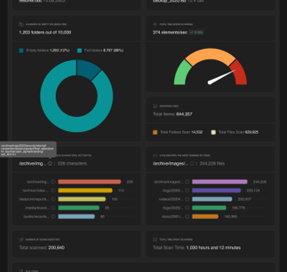


Scan. Classify. Act.
Know more. Do more. Move faster.
One closed loop, no exports in between.
Scan
Agentless, in-place scanning across NFS, Azure Blob, and AWS S3. A redesigned template-first workflow gets a scan running in minutes, with Create Custom Scan for power users.
Classify
Reusable search patterns tag every file by policy — PII, PHI, sensitivity, retention schedule — with duplicate detection inline and costs attached per category.
Act
Move, copy, or delete in bulk directly from the results. One decision drives action across millions of files, with hash re-verification before each one.
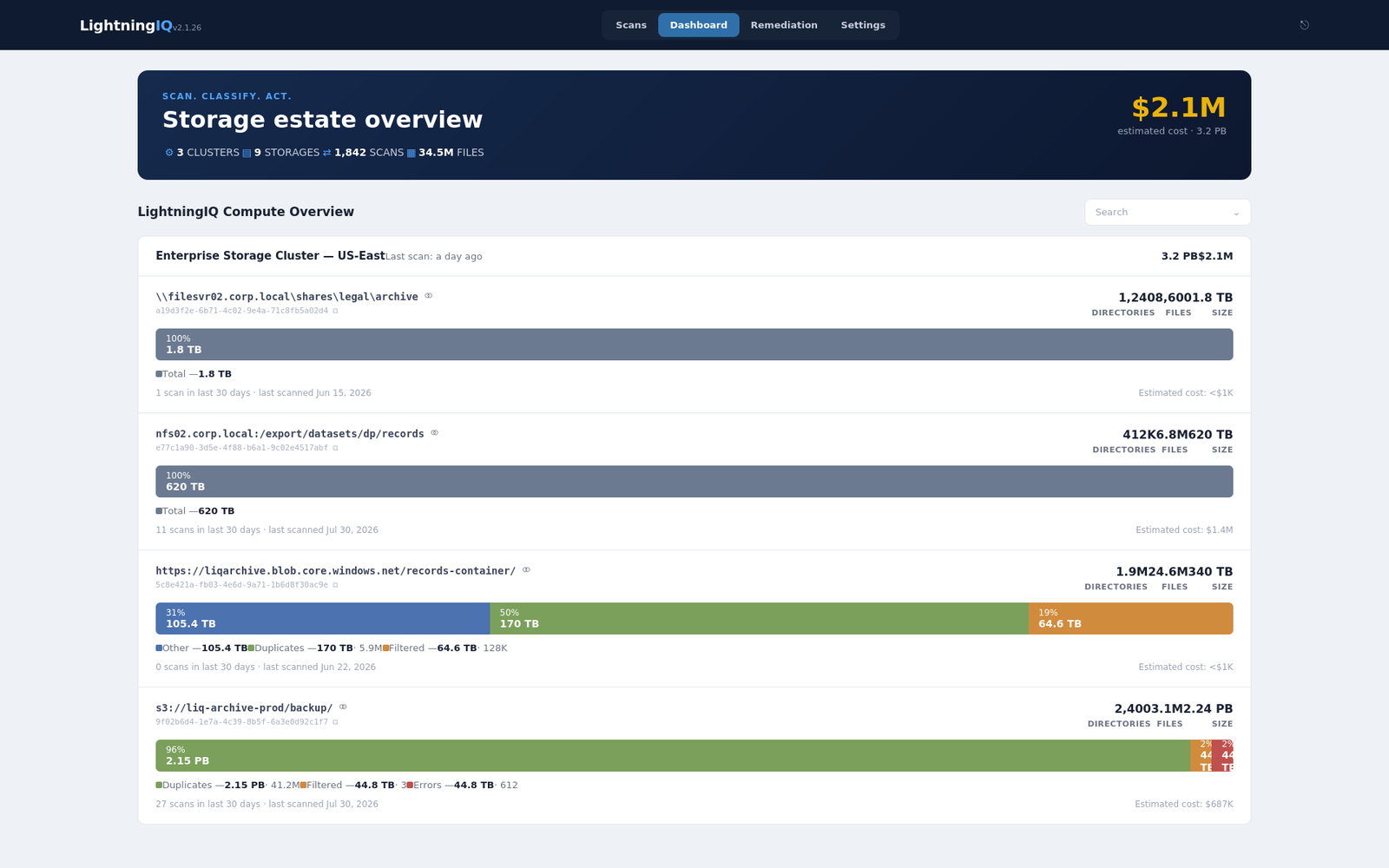
Terabytes per minute. Petabytes per hour.
Every category of junk data now carries a price tag.
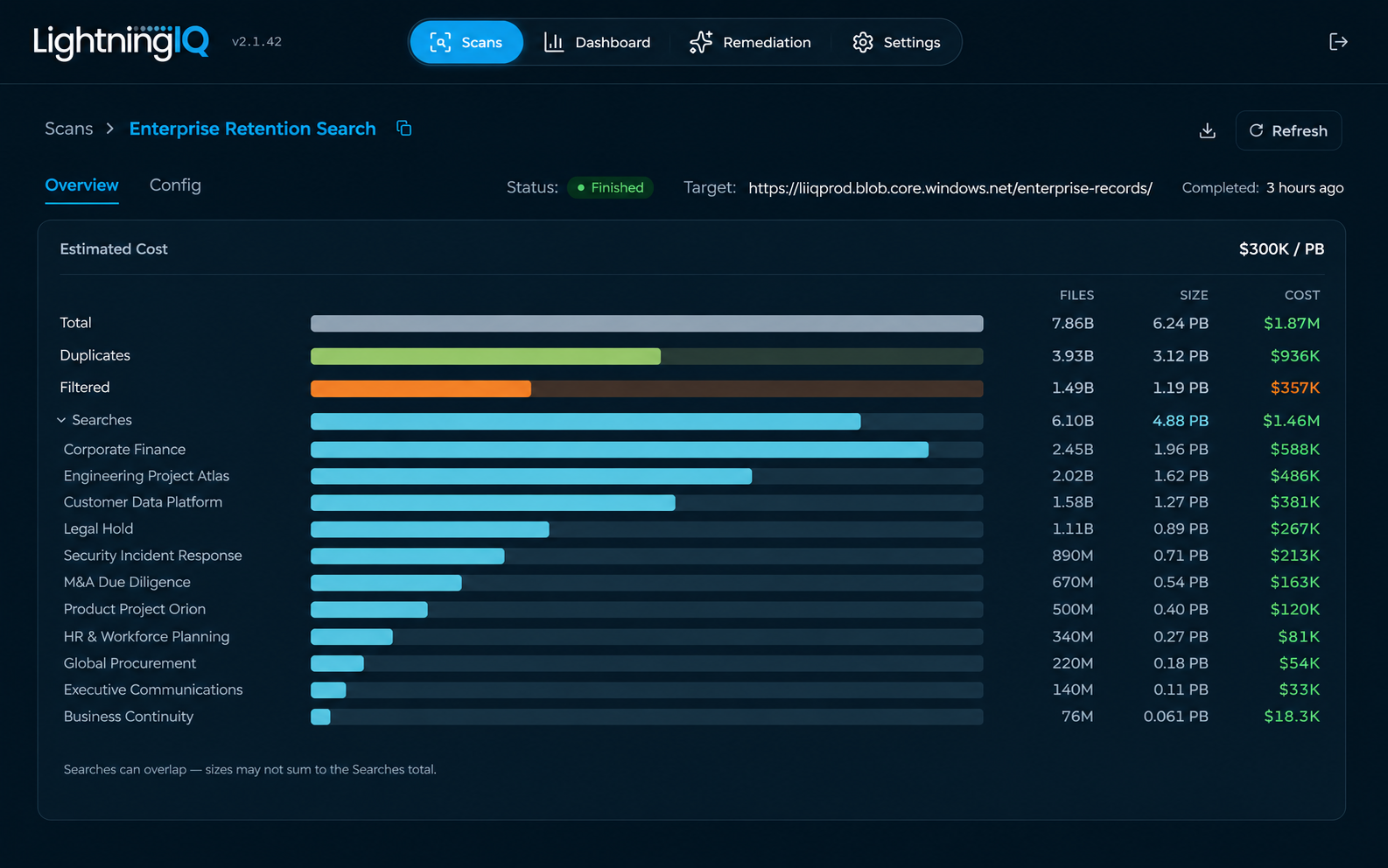
If you can point and click, you can run a petabyte-scale investigation.
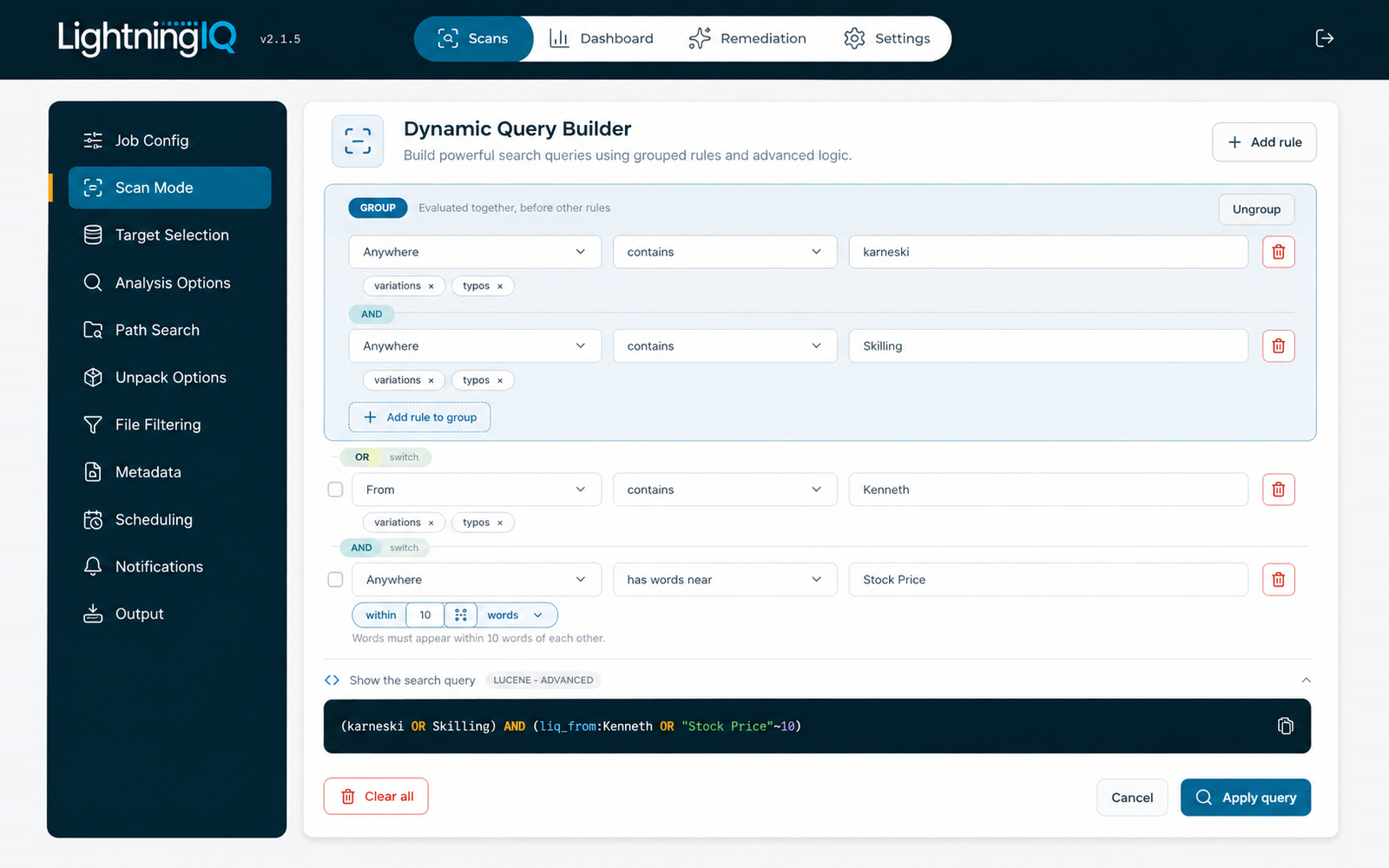
Dynamic query builder
Compose complex Lucene searches visually, with no syntax to memorize and nothing to mistype.
Custom and extrapolated metadata search
Filter on custom fields and machine-generated signals — classify against your retention schedule by computed properties, not filenames.
Scan completion notifications
Real-time lifecycle updates pushed to Slack, email, and other channels. No more checking on scans manually.
Redesigned scan workflow
Template-first setup for repeatable runs, plus Create Custom Scan when a matter needs something bespoke.
Every file, fully characterized.
PST ownership identification
Owners auto-derived from mail store properties, so abandoned and orphaned PST archives surface with a name attached.
Expanded media metadata
GPS coordinates, camera make and model, video timestamps, and audio tags captured during the scan.
Geographic distribution analytics
Map where a scan's data was created, how much of it, and when — useful for data residency and sovereignty questions.
Directory and file statistics
Largest directories by count and size, widest fanout, and deepest subdirectory trees across the estate.
File distribution by year
File count and file size by last-modified year — the fastest way to see how much of the estate stopped changing a decade ago.
Act at scale. Prove you acted correctly.
Every session returns succeeded, failed, and skipped counts with throughput and duration by action type.
Turn a petabyte scan into a dashboard.
Analytics exports
Structured output that drops straight into Power BI for self-service exploration — charts, slicers, drill-down into paths and categories.
Expanded legal export metadata
Email headers, document properties, and geolocation in .dat files, plus full family binaries rather than hits alone.
Transparent remediation reporting
Succeeded, failed, and skipped counts with throughput and duration by action type — an auditable record of what happened.
Reusable scan and export templates
Save a scan and export configuration once, then run it again at any scale with identical settings.
Less friction between you and the first scan.
Workload Identity and ADC for GCS
Authenticate Google Cloud Storage without long-lived service account keys.
Surfaced upload metrics and failure reasons
Tell configuration, authentication, and transient failures apart at a glance.
AD1 forensic support
Unpack AccessData Logical Image Files alongside live storage in the same scan.
Improved cloud storage handling
Leading-slash blob keys no longer error out, and the Storages panel scrolls properly at depth.
Everything in 2.0.
Act on your data
Prove the cost
Investigate faster
Richer intelligence
Feed your stack
Deploy cleaner
Daniel Pidutti · CEO, Lightning IQ