


The Definitive Guide Plan, budget & execute a smarter data center refresh.
The playbook for infrastructure, storage, and operations teams navigating refresh in the age of AI, exploding data growth, and skyrocketing compute and storage costs.
Why Data Center Refresh Is the Most Important, and Most Misunderstood, Project on Your Roadmap
Every three to five years, the same conversation happens in IT and infrastructure leadership meetings around the world: “It's time to refresh the data center.”
What used to be a relatively straightforward hardware lifecycle event — swap out aging servers, expand storage, modernize the network, rinse and repeat — has become something dramatically more complex. Today's data center refresh sits at the intersection of cost containment, compliance, cybersecurity, sustainability, and the single largest disruptive force in modern enterprise IT: artificial intelligence.
The math has changed. The stakes have changed. And the data has changed most of all.
Enterprise data is growing exponentially — yet most organizations still go into refresh cycles with surprisingly little visibility into what they actually store, who owns it, what it costs to keep, and whether any of it is still relevant to the business.
Treat your refresh not as a hardware project, but as a data intelligence project — and unlock dramatically better outcomes for your business.
What you'll find in this guide
A modern definition of refresh — and why the old playbook no longer works
The five strategic pillars of an intelligent refresh
A best-practice phased approach from discovery through optimization
Top 5 things every refresh team should do before signing a hardware PO
The Hidden Cost of “Cheap Storage” — and Why That Era Is Over
For a long time, the prevailing wisdom was that storage is cheap. When in doubt, keep everything. That logic does not make sense in 2026.
AI made compute scarce and expensive
Training, inference, RAG, vector embeddings, model fine-tuning — voracious consumers of premium-priced storage. Every gigabyte of junk you carry into an AI-ready environment competes for the most expensive infrastructure your company will ever buy.
Cloud storage scales linearly with what you keep
Cloud charges you every month, forever, for everything you keep. Egress fees punish you for moving data once it's there. Inactive data quietly drains millions from IT budgets every year.
Risk and compliance costs are skyrocketing
Every file you keep could contain PII, PHI, IP, or contractual obligations. Every one is in scope for a breach, a subpoena, a regulatory audit, or a DSAR. The cost is no longer storage — it's litigation, penalty, and reputation.
The most expensive part of your storage environment today is not the mission-critical data your business runs on. It's the petabytes you do not understand.
The Five Strategic Pillars of an Intelligent Data Center Refresh
Every effective refresh rests on five pillars. Treat any one as optional and you will pay for it later — in cost overruns, missed deadlines, or a post-migration incident.
Visibility
You cannot manage what you cannot see. A current, accurate, unified view across file shares, SAN, NAS, object storage, cloud buckets, archive tiers, and shadow IT.
Classification
Categorize data by type, business value, sensitivity, regulatory relevance, and retention requirement. Turn an undifferentiated pile into a structured inventory.
Risk & Compliance
Identify and reduce exposure as the estate moves — surfacing PII, PHI, IP, ownerless files, and over-permissioned shares before migration.
Cost & Footprint
The single biggest lever for ROI. Most enterprises can identify between 30% and 70% of existing storage as redundant, obsolete, or trivial.
AI Readiness
A refresh that delivers clean, structured, AI-ready data is dramatically more valuable than one that simply moves chaos to new infrastructure.
A Phased Best-Practice Approach to Data Center Refresh
The best refresh projects follow a predictable, repeatable pattern. Five phases, each with clear deliverables and decision gates.
Phase 1 · Discover
Establishes ground truth. Before any vendor conversations, RFPs, or sizing exercises, your team needs to know what's actually in the environment.
- Inventory all storage repositories (SAN, NAS, object, cloud, archive, backup)
- Map data owners and business units to repositories
- Identify dark data, orphaned files, and ownerless shares
- Surface initial signals of risk (PII, PHI, IP, sensitive content)
A complete, searchable inventory. Move from unknown and unseen to mapped and organized.
Phase 2 · Classify
Tag files by type, business function, sensitivity, regulatory relevance, and retention obligation. Automation is essential — manual classification does not scale.
- Automatically classify sensitive and critical data
- Tag data by type, risk, and regulatory relevance (GDPR, HIPAA, SOX, CCPA, PCI)
- Identify intellectual property and confidential business data
- Define retention and disposition rules per data category
Full visibility into what you have and what it means. Decisions become defensible.
Phase 3 · Control
With a classified inventory in hand, remediate risk, enforce governance, and eliminate data you no longer need.
- Apply access controls and remediate over-permissioned shares
- Defensibly delete ROT (redundant, obsolete, trivial) data
- Apply legal holds and retention policies
- Archive or tier infrequently accessed data
A smaller, cleaner, less risky data footprint — before you spend a dollar on new infrastructure.
Phase 4 · Migrate
Because you've already eliminated the ROT and classified what remains, your migration is faster, smaller, cheaper, and less risky.
- Sequence migrations by business priority and risk
- Validate data integrity at each step
- Map data to appropriate tiers (hot, warm, cold, archive)
- Coordinate cutover and validate post-migration access
A migration completed faster, at lower cost, with dramatically less risk than a lift-and-shift.
Phase 5 · Monitor & Optimize
Refresh is not done when the last byte lands. Mature organizations treat data intelligence as a continuous operating model.
- Schedule recurring scans (weekly, monthly, quarterly)
- Monitor for new sensitive data, anomalous activity, permission drift
- Maintain real-time dashboards for C-suite and audit
- Continuously optimize storage tiering and cost
Trusted, high-quality, AI-ready data — and a refresh cycle that gets easier every time.
Free Download · Definitive Guide
The Lightning IQ Definitive Guide to Data Center Refresh
A complete PDF version of this pillar page — formatted for sharing with your team, your CFO, and your executive sponsors. Print-ready.
Free Download · Quick Start
Identifying ROT & PII in Your Environment
A tactical, two-page checklist your storage and security teams can put to work this week. Defensible. Auditable. Ready to share with FinOps.
Top 5 Things to Do Before You Sign a Single Hardware PO
The five highest-leverage moves — every one of them happens before you commit a dollar to new infrastructure.
Scan everything — in place.
Get a complete inventory of what you're storing. The right scan technology runs in-place, requires no data movement, doesn't interfere with production, and completes in hours or days — not months.
Identify and eliminate ROT.
Most enterprises can eliminate 30–70% of unstructured data before refresh. Every gigabyte you remove is a gigabyte you don't have to buy, migrate, secure, or pay to store in the cloud forever.
Find and remediate sensitive data.
PII, PHI, IP, contracts, financial data, source code. Know where it is before you move anything. A refresh is the worst time to discover an open share with 40,000 patient records.
Right-size new infrastructure to actual usage.
Vendors love when you size based on existing footprint. Your CFO will love you when you size based on what you actually need — typically 30–60% smaller after ROT removal and tiering.
Build a data inventory that survives the refresh.
The data intelligence you generate during refresh has enormous ongoing value — for compliance, security, AI readiness, chargeback, and the next refresh. Treat it as a foundational asset.
How AI Is Reshaping Refresh Planning (and Why It Matters Now)
AI has rewritten the data center playbook. If your refresh planning still assumes pre-AI patterns, your sizing is almost certainly wrong.
Data growth is accelerating, not stabilizing
Generative AI tools — internal copilots, content generation, automated documentation, AI agents — produce massive amounts of new unstructured content. Drafts, transcripts, embeddings, vector indices, model artifacts.
Data quality matters more than data quantity
AI initiatives live or die based on the quality of the data they're trained on or retrieve from. A refresh that delivers clean, classified, well-organized data improves the ROI of every downstream AI investment.
AI introduces new categories of risk
Training on data containing PII, PHI, or confidential IP creates regulatory exposure that didn't exist before. RAG pipelines can surface confidential content to unauthorized users. Segregating sensitive data before it flows into AI is no longer optional.
Treat AI readiness as a first-class refresh outcome, not a “phase 2” problem. The teams that bake AI readiness into refresh planning will spend less, move faster, and ship more credible AI initiatives over the next three years than those who do not.
Practical Checklists for Refresh Teams
Use these as a starting point. Adapt them to your organization, your industry, and your specific refresh scope.
Storage Team
- Complete inventory of all storage repositories (on-prem, cloud, hybrid, edge)
- Current utilization, growth rate, and 36-month projection per repository
- File type, age, and ownership distribution
- Identified ROT volume and target reduction percentage
- Tiering analysis (what's hot, warm, cold, archive)
- New environment sized against post-cleanup footprint, not current footprint
Security & Compliance
- Sensitive data discovery completed (PII, PHI, IP, financial, regulated)
- Stale and over-permissioned shares identified and remediated
- Ownerless and orphaned data triaged
- Legal hold preservation verified
- Chain of custody maintained through migration
- Audit log of all disposition decisions retained
Finance & FinOps
- Documented cost-per-TB before refresh (storage, backup, DR, cloud)
- Projected cost-per-TB after refresh
- ROT elimination quantified in dollars saved
- Chargeback/showback model updated
- Three-year TCO projection signed off by IT and Finance
Executive Sponsorship
- Clearly stated business outcomes and success metrics
- Risk register reviewed and signed off
- Executive communication plan in place
- Quarterly progress reviews scheduled
- Post-refresh data intelligence operating model defined and funded
From Data Chaos to Real-Time Intelligence
Organizations progress through five stages of maturity. Use refresh as the forcing function to climb at least one.
Discover
Scan all repositories on-prem, in the cloud, and hybrid. Identify where data lives and what exists. Surface dark data, ROT, and unknown risks.
Classify
Automatically classify sensitive and critical data. Tag by type, risk, and regulatory relevance. Build a complete, searchable inventory.
Control
Apply access controls, enforce policies, meet compliance requirements, enable defensible deletion and lifecycle management.
Monitor
Scan continuously. Detect new risks, sensitive data, and anomalies in real time. Deliver dashboards and alerts enterprise-wide.
Optimize
Deliver clean, structured, AI-ready datasets. Reduce storage costs and infrastructure footprint. Power advanced analytics and innovation.
A data center refresh is the periodic re-architecting of an organization's compute, storage, network, and data management environment to align with current business needs, technology capabilities, and cost and risk realities. Most enterprises run on a three- to five-year refresh cycle, though many are moving to continuous, incremental refresh models for at least part of their infrastructure.
Most enterprises operate on a three- to five-year cycle, driven by hardware end-of-life, vendor support windows, and the typical depreciation schedule for capital infrastructure. The right cadence depends on workload growth rate, regulatory environment, AI ambitions, and cloud strategy.
A reasonable expectation is that 30% to 70% of unstructured data qualifies as redundant, obsolete, or trivial. Eliminating it before refresh translates directly into smaller hardware purchases, lower cloud spend, faster migrations, and lower ongoing operational costs.
ROT stands for Redundant, Obsolete, and Trivial data. Examples include duplicate files, files belonging to former employees, expired retention periods, old backups, abandoned project folders, and system-generated artifacts. ROT is one of the largest single contributors to storage cost, security exposure, and migration complexity.
Dark data is data that an organization collects, processes, and stores but does not actively use. It often lives in forgotten file shares, legacy systems, and archive tiers — and frequently contains sensitive information the organization has lost track of.
End-to-end refresh projects typically run 12 to 24 months. The Discover and Classify phases — historically the longest and most painful — can be compressed dramatically with modern in-place scanning technology, often from months to days or weeks.
It depends. Cloud is the right answer for some workloads and the wrong answer for others. The key is to decide based on facts: workload performance, data sensitivity, access patterns, regulatory requirements, and full three- to five-year TCO including egress.
The strongest business cases combine four elements: hard cost savings from footprint reduction, risk reduction from sensitive data remediation, operational improvement from modernized infrastructure, and strategic enablement for AI and analytics.
Data-in-place scanning analyzes data where it lives — without copying, moving, or indexing it into a separate system. It avoids the cost, time, risk, and disruption of traditional discovery, letting you understand petabytes of data in hours or days rather than months.
AI changes the equation in three ways: it dramatically accelerates data growth, it raises the bar on data quality, and it introduces new categories of regulatory and confidentiality risk.
Discovery is the process of finding and inventorying data — knowing what exists and where. Classification is the process of categorizing that data — knowing what it is and what it means to the business. You need both, in that order.
Model the cost of ROT removal. A 30%+ reduction in storage footprint typically translates to seven- or eight-figure savings on hardware, cloud, backup, DR, and operations over the life of the refresh. The investment usually pays for itself within the refresh project itself.
FinOps brings the cost discipline that refresh projects desperately need. The best teams pull FinOps in at the very beginning, so chargeback models, tiering strategies, and TCO projections are built into the design rather than reverse-engineered afterward.
At minimum: total data volume scanned, ROT identified and eliminated, sensitive data discovered and remediated, footprint reduction percentage, migration velocity (TB/day), risk findings closed, and projected vs. actual cost.
You inherit every problem you had in the old environment, plus a few new ones. Storage costs scale up rather than down, sensitive data exposure migrates intact, dark data keeps growing, and AI initiatives inherit a pile of bad inputs. Lift and shift is the most expensive refresh strategy available.
Lightning IQ is purpose-built to power the Discover, Classify, Control, Monitor, and Optimize phases of refresh — at petabyte scale, in place, in hours rather than months. We're the data intelligence layer that makes every other decision in your refresh smarter, faster, and more defensible.
How Lightning IQ Powers a Smarter Refresh
The data intelligence layer that turns refresh from a guessing game into a data-driven decision.
Lightning IQ is purpose-built to power the Discover, Classify, Control, Monitor, and Optimize phases of refresh — at petabyte scale, in place, in hours rather than months.
Blistering speed
Scan and analyze 100 billion records — 25+ petabytes — per day. Finish in hours what other tools take months to complete.
Data-in-place scanning
No data movement. No shadow indices. No production impact. Analyze data where it lives, across SAN, NAS, object, cloud, and hybrid.
Automated classification
Identify sensitive, redundant, and high-value data instantly. PII, PHI, IP, ROT, ownerless files, stale permissions — all surfaced automatically.
Risk & compliance intelligence
Built-in support for GDPR, HIPAA, SOX, CCPA, PCI, and internal governance frameworks. Generate auditable, defensible reports.
Effortless deployment
Fully automated, infrastructure-as-code deployment in minutes. No agents to install. No long professional services engagement.
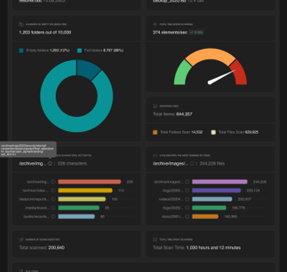
Real-time dashboards
Move from one-time discovery to continuous data intelligence. Daily and weekly scans, real-time risk alerts, C-suite reporting.
Ready to refresh smarter?
Your next refresh will be the largest IT capex in this planning cycle. Make it count.
Schedule a 30-minute walkthrough. We'll show you what Lightning IQ surfaces in your environment — ROT, dark data, sensitive data — in hours, not months.